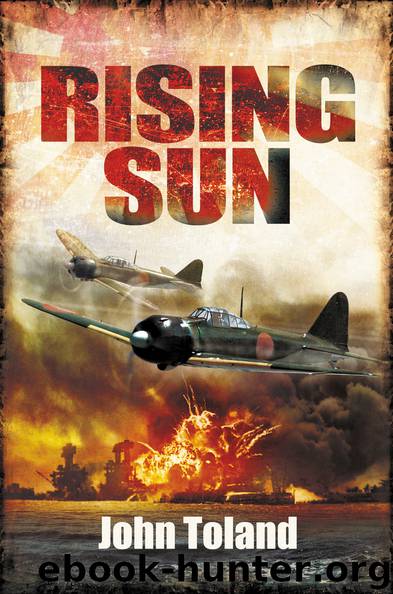
Rising Sun by John Toland
Author:John Toland
Language: eng
Format: epub
ISBN: 9781848849525
Publisher: Pen and Sword
2.
The new American thrusts had forced Imperial Headquarters to readjust their defenses. The desperate scramble of the Army and Navy for appropriations, strategic materials and factories centered on plane production, since both services agreed that the way to victory lay in the air. They agreed to share equally the 45,000 planes to be produced the following year. But a month later, in early January 1944, the Navy requested more than their allotment–26,000 planes.
The Navy’s case was persuasive and Tojo acquiesced. “This is too great a problem to settle so quickly,” protested his friend and adviser, Kenryo Sato. Until this time the Supreme Command had depended on the Navy to win the Decisive Battle against America on the seas, but now that dream was over. Henceforth the Army would have to play the major role, and the small islands that lay between the advancing Americans and Japan would have to be the “unsinkable carriers,” bases for future land battles. The majority of planes, therefore, would have to go to the service that fought these battles, the Army.
Tojo realized that his first decision had been prompted by a desire to keep peace with the Navy. Sato was obviously right and Tojo told him to inform the Navy of the change in priorities. The Navy, in turn, refused to accept the reversed decision. On February 10 the battle was openly joined at a meeting of the Chiefs of Staffs and their advisers at the Palace. Admiral Nagano maintained that the crucial battles with the enemy would still take place at sea. He was challenged by Army Chief of Staff Sugiyama, who had been promoted to field marshal. “If we gave you all the planes you want, would this battle turn the tide of war?”
Nagano bristled. “Of course I can’t guarantee anything of the kind! Can you guarantee that if we gave you all the planes, you would turn the tide?”
Distracted by a suggestion from Admiral Oka that they all take a break for tea, the antagonists calmed down, but the problem remained unsolved until Sato came up with an ingenious if questionable solution: concentrate production on fighters to the exclusion of bombers. Then an additional 5,000 planes, a total of 50,000 for equal distribution, could be manufactured, only 1,000 shy of the Navy’s demand for 26,000 planes. To make up for this deficit, Sato offered 3,500 tons of aluminum. The Navy accepted.
The tempest was over but not the military problems which had aggravated it. The American advance through the central Pacific continued unchecked. On February 17 Nimitz’ amphibious force leapfrogged from Kwajalein to the Eniwetok islands at the western limit of the Marshalls, by-passing four atolls where the Japanese had air bases. That same day and the next, American carrier planes also attacked Truk in the Carolines, the home of Combined Fleet, destroying seventy planes on the ground and sinking two auxiliary cruisers, a destroyer, an aircraft ferry, two submarine tenders and twenty-three merchant ships–200,000 tons of shipping in all.
These successive disasters prompted
Download
This site does not store any files on its server. We only index and link to content provided by other sites. Please contact the content providers to delete copyright contents if any and email us, we'll remove relevant links or contents immediately.
| Africa | Americas |
| Arctic & Antarctica | Asia |
| Australia & Oceania | Europe |
| Middle East | Russia |
| United States | World |
| Ancient Civilizations | Military |
| Historical Study & Educational Resources |
The Sympathizer by Viet Thanh Nguyen(4393)
The Rape of Nanking by Iris Chang(4213)
World without end by Ken Follett(3477)
Ants Among Elephants by Sujatha Gidla(3467)
Blood and Sand by Alex Von Tunzelmann(3205)
Japanese Design by Patricia J. Graham(3178)
The Queen of Nothing by Holly Black(2599)
City of Djinns: a year in Delhi by William Dalrymple(2555)
Foreign Devils on the Silk Road: The Search for the Lost Treasures of Central Asia by Peter Hopkirk(2465)
India's Ancient Past by R.S. Sharma(2455)
Inglorious Empire by Shashi Tharoor(2443)
Tokyo by Rob Goss(2432)
In Order to Live: A North Korean Girl's Journey to Freedom by Yeonmi Park(2392)
Tokyo Geek's Guide: Manga, Anime, Gaming, Cosplay, Toys, Idols & More - The Ultimate Guide to Japan's Otaku Culture by Simone Gianni(2373)
India's biggest cover-up by Dhar Anuj(2355)
The Great Game: On Secret Service in High Asia by Peter Hopkirk(2349)
Goodbye Madame Butterfly(2254)
Batik by Rudolf Smend(2185)
Living Silence in Burma by Christina Fink(2072)
